WHAT'S INSIDE

Eight modules,
fully built out.

Every screen below is the shipping app, not a mockup. Guest mode is a device-local preview; a free account unlocks the full iOS app and sync.

Question Bank

850+ clinical questions, with the reasoning spelled out.

The question bank spans cardiovascular, respiratory, neuro, renal, metabolic, and multisystem critical care. Every answer opens into the reasoning; newer items carry a structured rationale with why-correct, why-wrong for each distractor, a clinical pearl, and citations. Guest mode includes a 150-question preview; a free account unlocks the full bank, flags, timers, custom tests, review queues, and spaced repetition.

  • Why Correct / Why Wrong Not an answer key: each option gets its own reasoning, so the distractors teach as much as the answer.
  • Clinical Pearls The pattern worth keeping, pulled out of the rationale and into a pearl you can carry to the bedside.
  • Category Tracking Accuracy by system over time. Find the gap, then close it.
  • Spaced Repetition Missed questions return on the right day. Easy ones space out. The system optimizes your time.
  • Per-Session Shuffle Answer letters shuffle every session, so you learn the content, not the position.
  • Custom Tests & Flags Build focused sets by topic, count, and timer; flag anything to revisit on your terms.
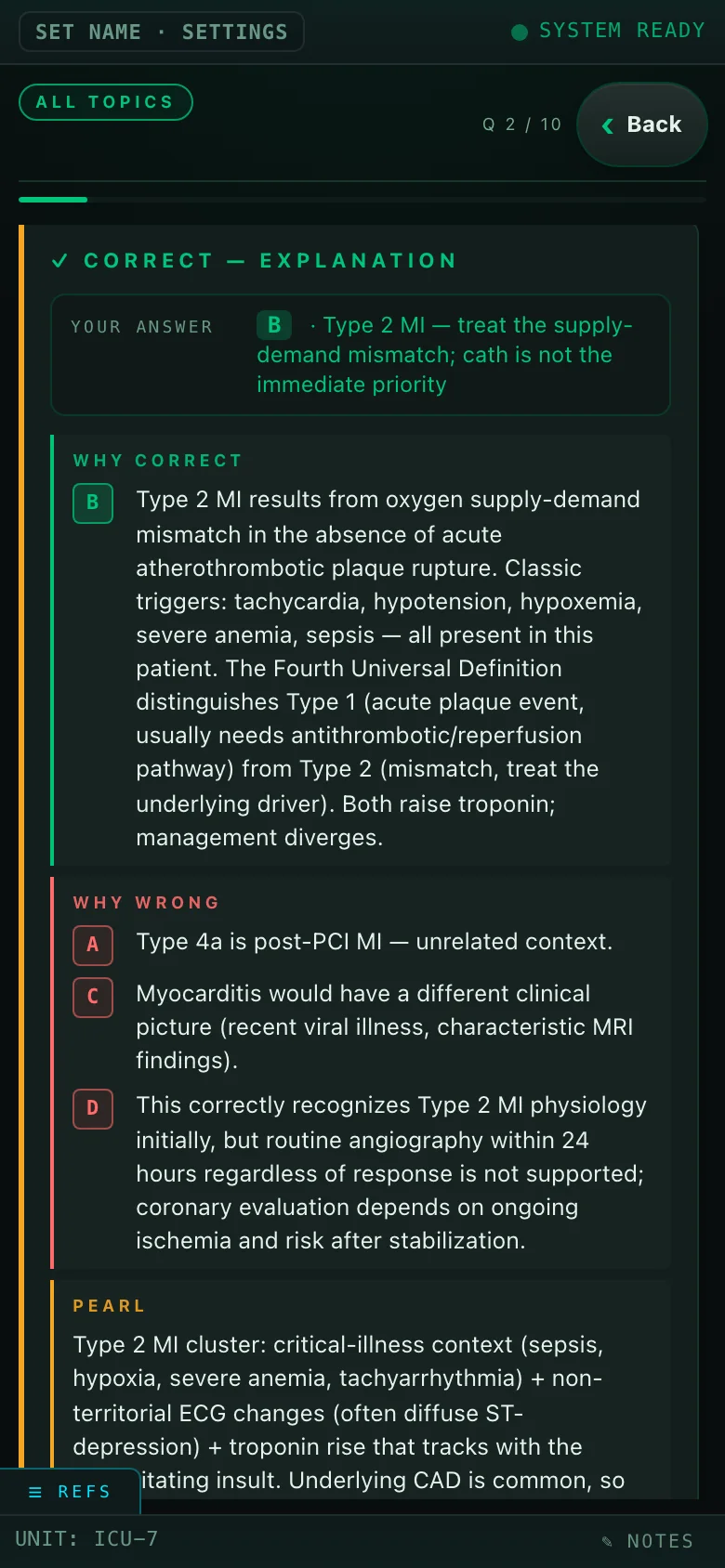
Question bank rationale screen: correct answer explanation with WHY CORRECT, WHY WRONG for each option, and a clinical pearl.
Simulation

Run the case. Watch the physiology answer.

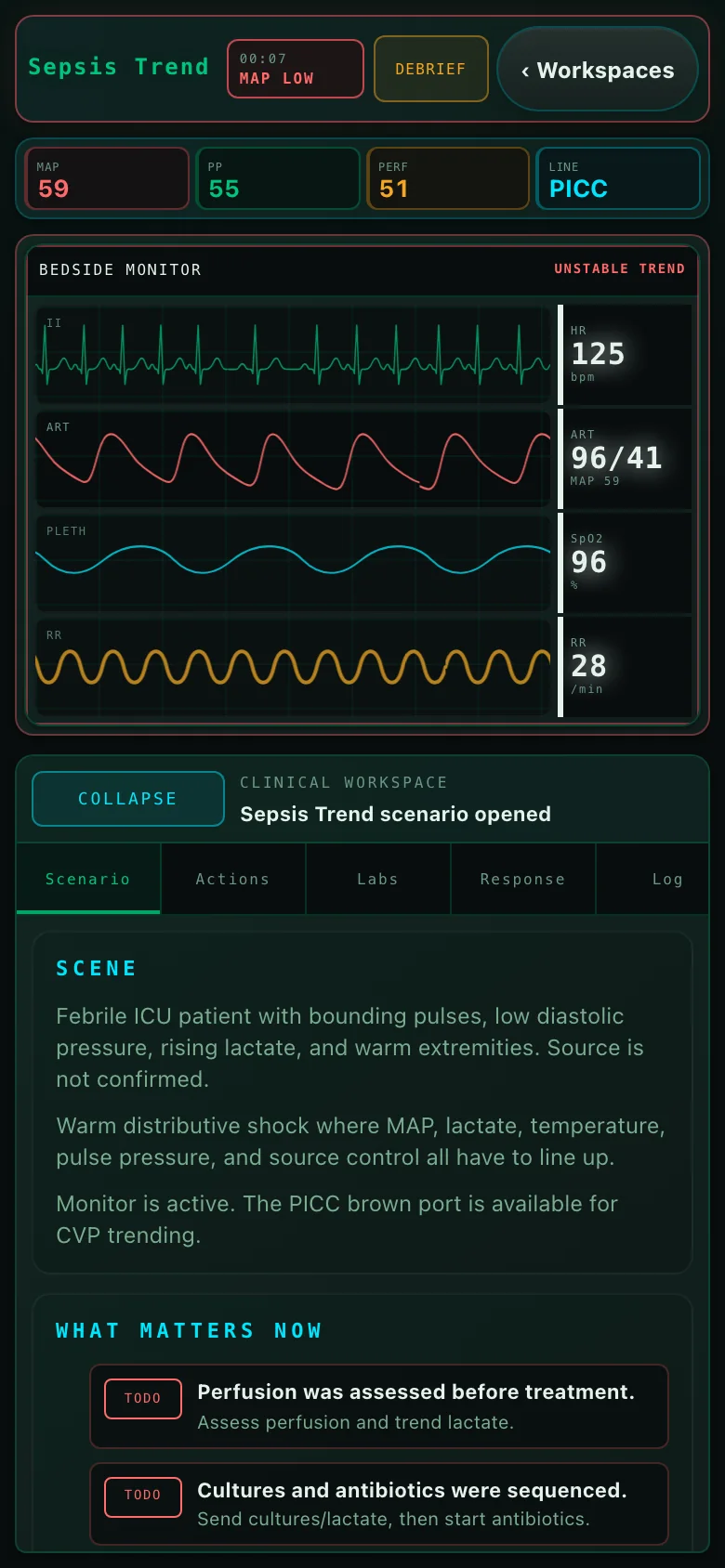
Bedside simulation drops you onto a live monitor with a deteriorating ICU case. Make a call (a drug, a vent change, a pacer setting) and the modeled physiology responds. Guest mode opens the Basic Vitals workspace; a free account unlocks the pacer, Swan/CCO, and ventilator workspaces.

  • Real-Time Monitor ECG, arterial line, pleth, and respiratory traces trend together with the case.
  • Clinical Workspace Scenario, actions, labs, response, and log: the whole encounter in one place.
  • Modeled Physiology Pressure, flow, and gas exchange respond to what you do, not to a fixed script.
  • Debrief Every case closes with what improved the patient and what did not, tied to the scenario objective.
Bedside simulation of a sepsis case: four live waveforms, unstable-trend banner, and the clinical workspace tabs.
Hemodynamics

Hemodynamics, from circuit to shock call.

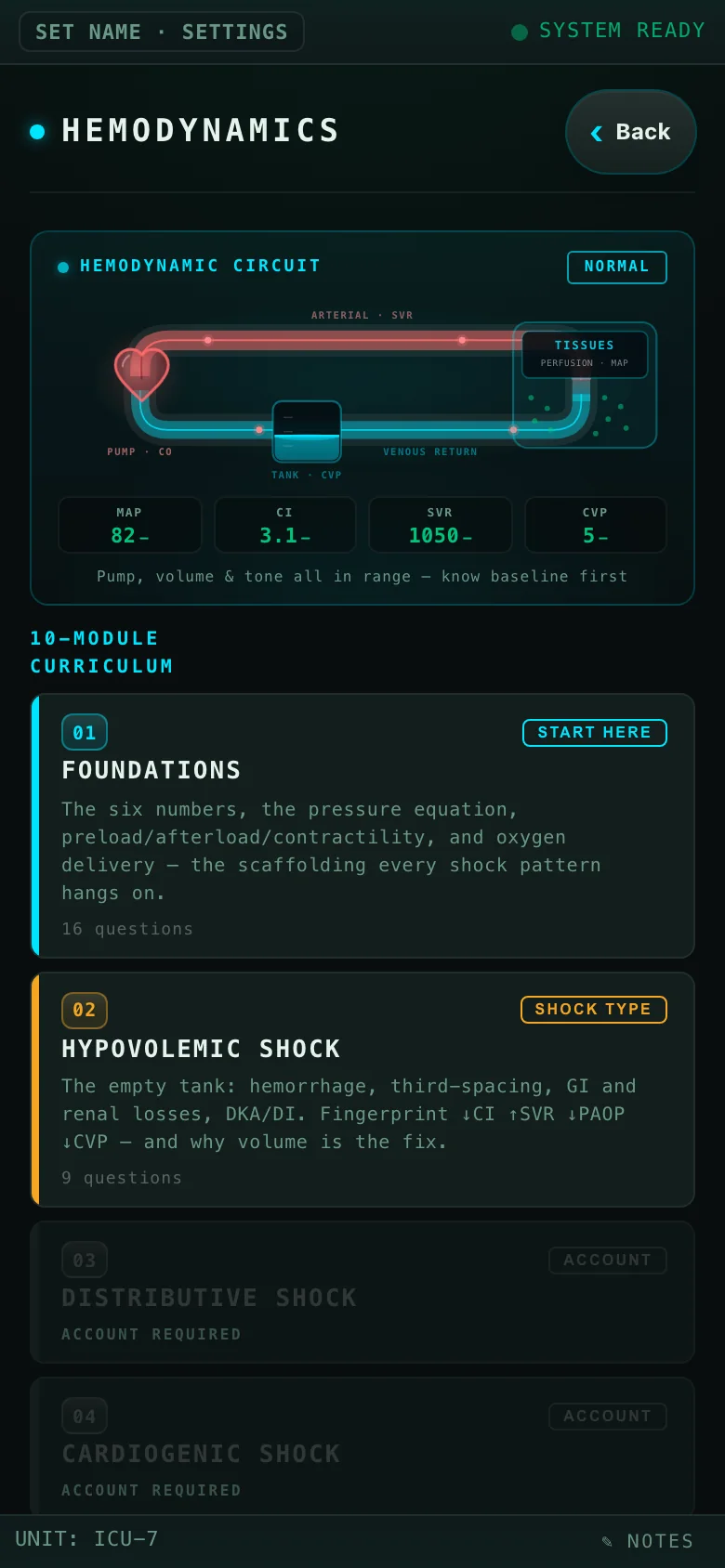
The deepest module in the app: a live hemodynamic circuit, a ten-module curriculum, and drill modes shaped around how clinicians actually build hemodynamic intuition: pattern first, numbers second. Guest mode opens the starter modules; a free account unlocks the full pathway.

  • Hemodynamic Circuit Pump, tank, and tone: a living model that shows how MAP, CI, SVR, and CVP move together.
  • Shock Recognition Read real ICU values. Name the shock: broad family, then specific subtype.
  • Clinical Decisions You have the profile. Choose the intervention: fluids, pressors, inotropes, and more.
  • Build the Profile Mastery mode: given only the shock type, reconstruct the entire hemodynamic profile from memory.
  • Escalation Arcs One patient, three turning points: the full deterioration arc from recognition to escalation.
Hemodynamics module: animated circulation circuit with MAP, CI, SVR, and CVP readouts above the curriculum.
EKG Trainer

EKG that teaches you to read, not memorize.

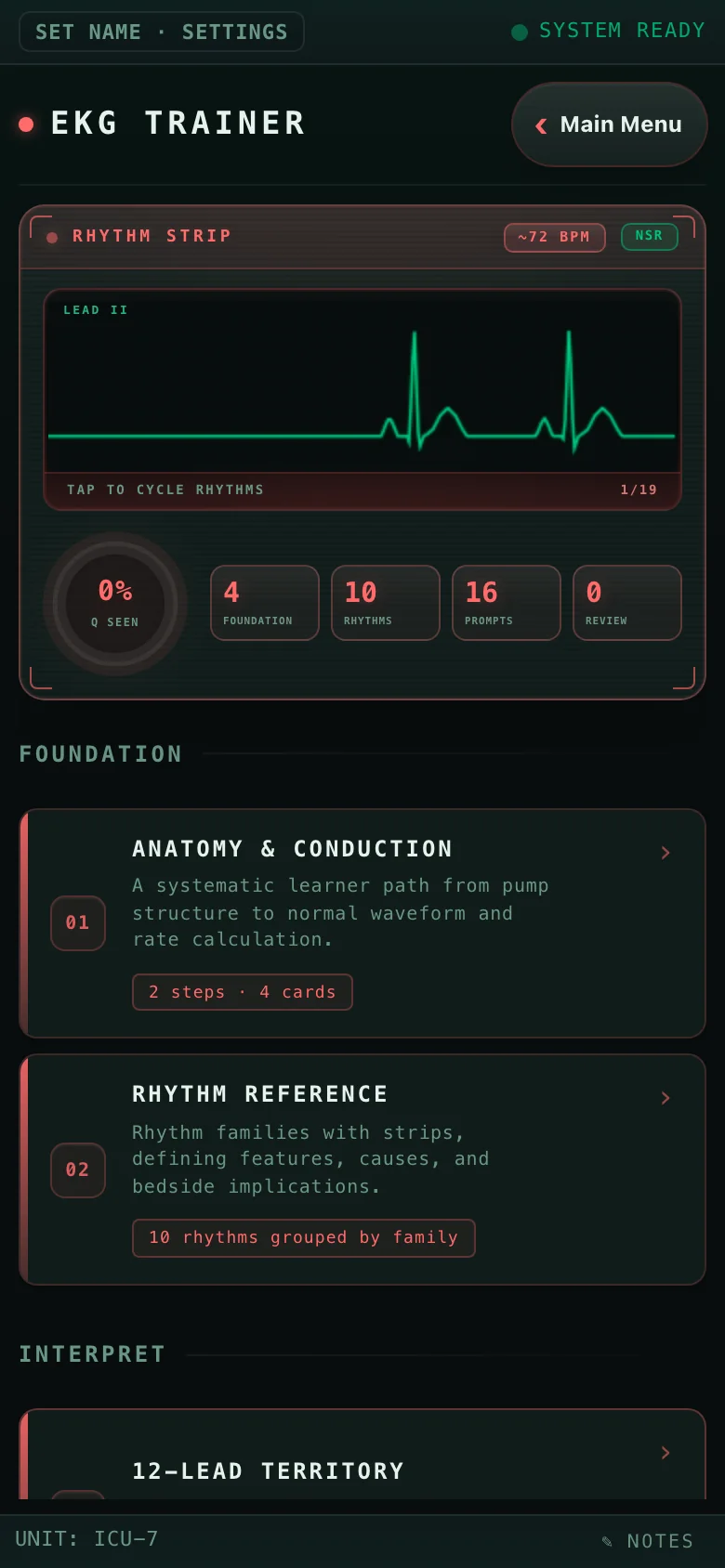
Anatomy → strips → lead-by-lead infarct localization. Each layer reinforces the previous one so rhythm reasoning becomes automatic instead of recalled. Guest mode starts the foundation path and rhythm references; a free account unlocks the full trainer.

  • Conduction Anatomy How the signal moves through the heart, mapped onto the surface EKG so you read with mental geography.
  • Rhythm Reference A clean, scrollable rhythm library, from sinus tach to torsades, with the distinguishing features pulled out.
  • 12-Lead Territory Lead-by-lead infarct localization: which artery feeds which territory, which leads cover which wall.
  • Test Yourself Self-graded practice with focused feedback on what you missed and why.
EKG trainer with a live lead II rhythm strip and the foundation curriculum below.
Study Modules

Concept first. Then check yourself.

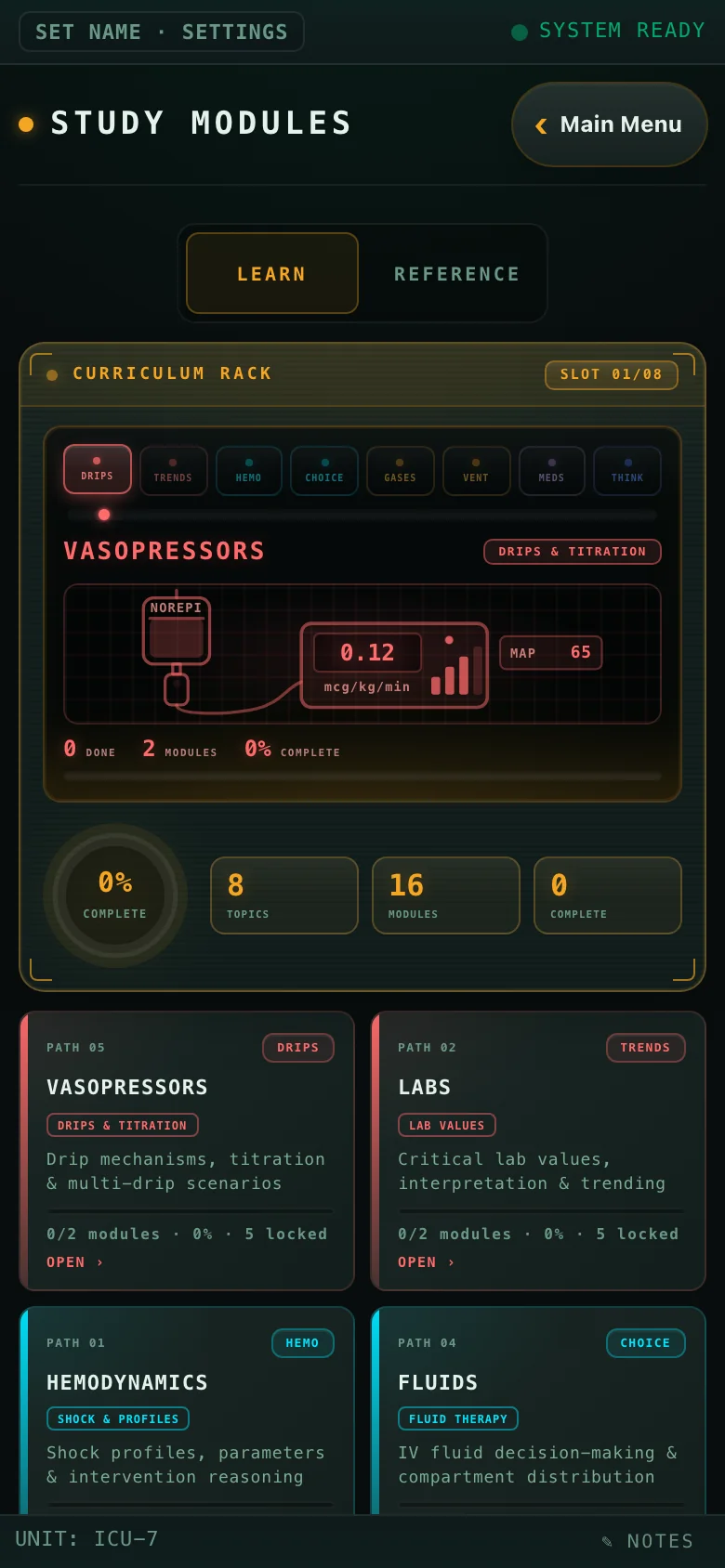
Each study module works one ICU domain end to end: teach the concept, then check yourself, so understanding builds before speed. Eight topics, from vasopressors to advanced ICU reasoning. Guest mode opens the first two modules in each curriculum; a free account unlocks the full set.

  • Vasopressors Match the shock state to the right pressor. Recognize when to add an inotrope, and when fluids come first.
  • Labs Critical values, electrolyte derangements, and what to act on now.
  • Fluids Resuscitation, maintenance, replacement: when to pick which, and why.
  • ABG Acid-base interpretation step by step. Mixed disorders included.
  • Ventilator Mode selection, troubleshooting alarms, weaning, and dyssynchrony recognition.
  • Pharmacology Receptors, infusions, and the ICU formulary: how the drugs work before you reach for them.
Study Modules curriculum rack with the vasopressors module active, showing a norepinephrine drip visual with dose readout.
Medications

ICU pharmacology, from receptor to bedside.

A dedicated home for ICU drugs (pressors, sedation, anticoagulation, antimicrobials, and the high-stakes infusions), built as a curriculum that runs from receptor to dose to titration, with case practice that makes you choose. Guest mode includes the reference and a question preview; a free account unlocks the full curriculum, spaced review, and cases.

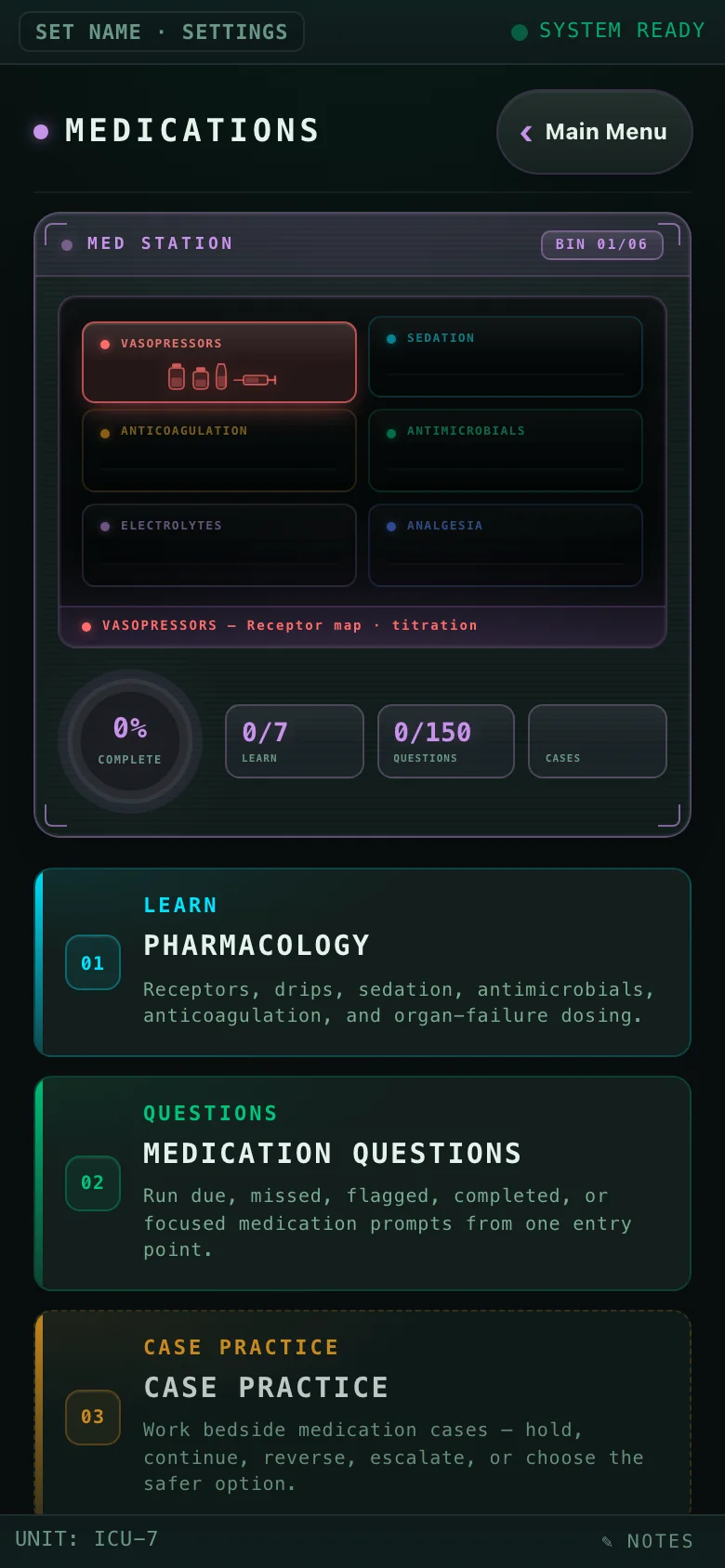
  • Med Station Six drug bins (vasopressors to analgesia) organized the way you reach for them.
  • Pharmacology Curriculum Receptors and infusion physiology, class by class: concepts before numbers.
  • Case Practice Bedside medication decisions: hold, continue, reverse, escalate, or choose the safer option.
  • Built for Infusions Pressors, inotropes, and sedation: mixing, dosing, and titration for the drips you run.
Medications module: med station with six drug-class bins and the pharmacology, questions, and case practice paths.
Clinical Tools

Reference, calculators, protocols. One tap from home.

The tools section is built for the moments you need a reference between cases, not when you have time to crack open a textbook. Guest mode keeps core references and basic tools available; a free account unlocks advanced calculators, protocols, specialty guides, and device trainers.

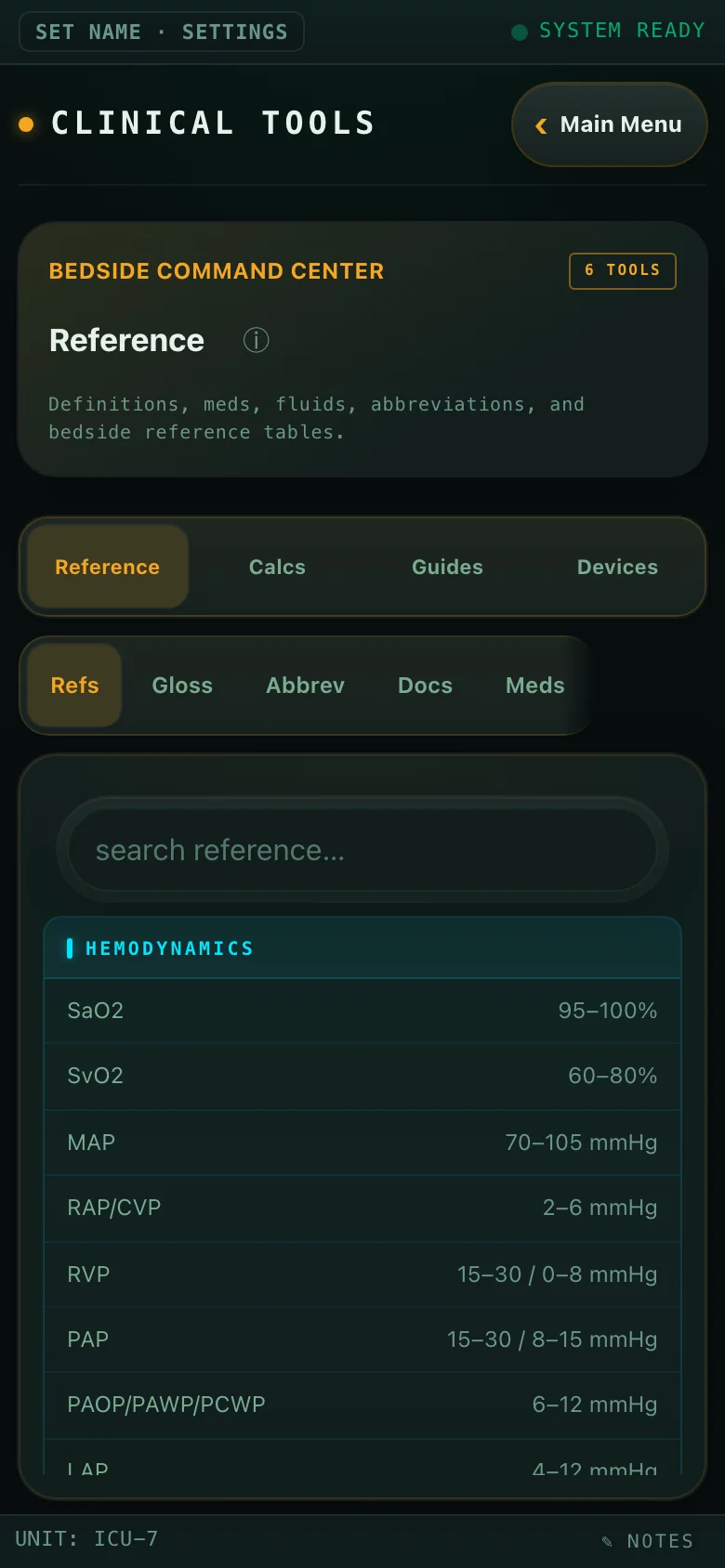
  • Calculators MAP, CI, SVR, P/F ratio, anion gap, IBW (Devine), free water deficit, Fick CO. Educational implementations of standard published equations.
  • ICU Protocols Sepsis bundle, ARDS, post-cardiac arrest, DKA, withdrawal scales, all organized by category and color-coded by domain.
  • Drug References Indication-first organization. What you reach for, not the alphabetical position.
  • Ventilator Modes Pressure vs volume, control modes, weaning modes, troubleshooting flowcharts.
  • Device Guides Pacers, IABP, CRRT: the basics you need before the conversation starts.
Clinical tools: bedside reference tables with normal hemodynamic ranges, plus calculators, guides, and device tabs.
Progress & Account

Your reasoning, tracked and carried with you.

A live picture of how your clinical reasoning is improving, synced across devices when you open the vault with a free account. Guest progress stays on the device; an account adds Saved, flags, full review analytics, cloud backup, and sync.

  • Daily Activity Streaks and a calendar of which days you trained. No guilt-tripping, just visibility.
  • Category Accuracy Your accuracy in cardiovascular vs respiratory vs neuro over time.
  • Unified Review Queue One spaced-repetition queue across all modules: the right concept on the right day.
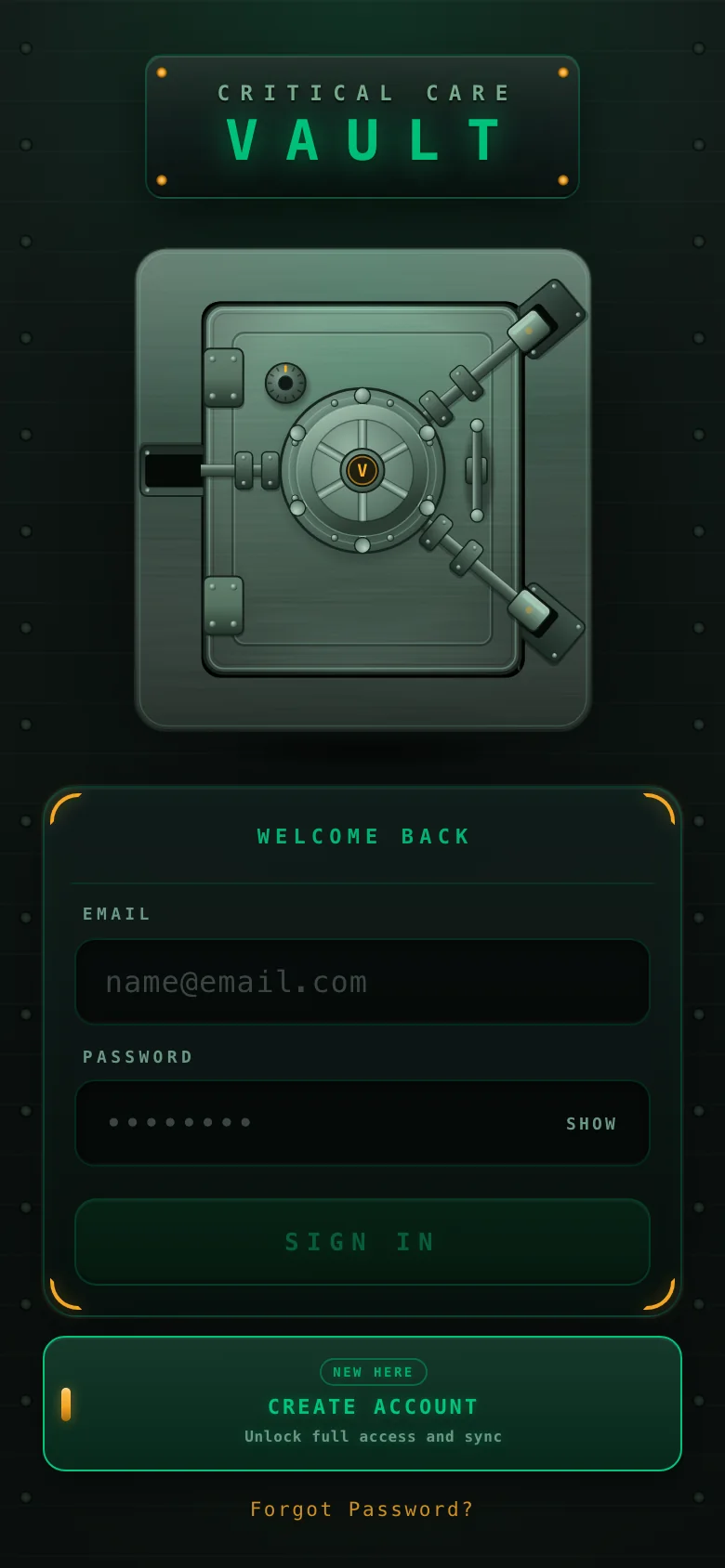
  • Cloud Sync Email + password account → progress, Saved, and review history on every device you use.
The vault door sign-in screen, where you create a free account to unlock the full library and sync.

Ready when you are.

Free on iOS: the full app with a free account. No ads, no trackers.